Saturday, February 17, 2007

Epic day in Coimbatore

For my first full day in India, Leah had planned to cram her 4 day tour into one. I didn't realize this until late morning after a whirl wind of visits. Here is the short version of my first day...

7:00am - Visit Organic Farm
After an almost 40 hour travel day, I finally got to bed at about 11:30pm, still buzzing from the sound of the turbine plane engines. Our plan called for us to wake up at about 6:15 and leave at 7:00am. Of course, I awoke at about 4:30am, my body still not sure what it was supposed to do. Another 4 hour night... not what I was hoping for. Still, I felt fine and after resting until 6:00am and then showering, I was ready to get started. We drove about 15min to the farm where we would learn more about the important role of the cow, and all its "by products" in the cycle of the organic farm. We talked about the incredibly harmful effects of pesticides and GM (genetically modified) cotton seeds on the soil and on the environment in general. The whole purpose of Organic farming is to restore the natural balance that chemicals and GM seeds have destroyed over the past 50 years or so. Our first stop provided an excellent base to begin my journey into the world of organic cotton.

8:00am - Breakfast
We returned to our wonderful host's beautiful home. The plan was a quick breakfast with the family before we set off on the rest of our day. Our hosts graciously set the table with forks and spoons for my benefit, even though food is traditionally eaten with hands. They also prepared a "less spicy" version of the food for my sensitive western palate. I was happy to eat the mild dish with my hands.

9:00am - School
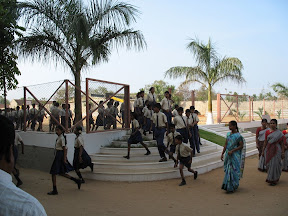
Directly across the street from our host was a small private school that was situated on part of the family land that is also occupied by the ginning factory. The school was built and funded by the family trust, and 20% of the children attending the school were sponsored (free tuition) by the trust. The school was clean and airy, and in the first room was about 30 computers. There are 30 children per class, kindergarten to grade 10. The kindergarten is taught Montessori style and the children start there at about age 2. The children were milling about before morning assembly in their crisp uniforms and bright faces. The teachers and principle all greeted us very warmly, proudly showing off their school. We stopped at the gym which contained a 10-12ft wooden pole and a rope hung from the ceiling. We watched as a young boy demonstrated a traditional Indian gymnastics routine on the pole, which appeared to meld gymnastics, yoga in a cirque du soleil type routine. The young girl followed with her routine on the rope. We later learned that this traditional sport had died off for a time and was being revived. Our two demonstrators had recently placed highly at the national competition held at this school. As we prepared to finish our quick tour, the children began to migrate toward the track field for the morning assembly. The children in the kindergarten had their own assembly around the corner from the rest of the children. We watched as the assembly sang brief prayers (non-denominational) of thanks. Next we knew, we were ushered in front of the assembly of 550 children to present awards of a recent competition. This was a surprise, and neither Leah nor I had brought the camera since Leah had taken the tour already! We were announced as honored guests from Canada and the USA. It was quite a surprise and an honor. It was only 9:30am...

9:30am - Visit ginning plant
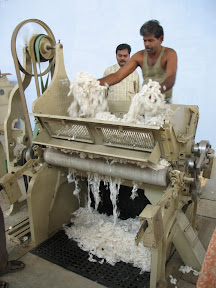
Next door to the school is the family's ginning facility. This is where the raw cotton is shipped and the seed and waste is separated from the cotton. After a whirlwind tour, we were off to our next stop...

10:00am - Hand looms
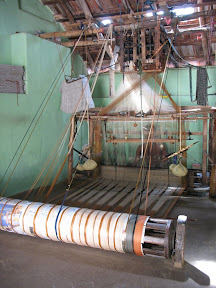
We drove for about 10 minutes to a nearby village that specialized in handloomed saris, the beautiful fabric worn by traditional Indian women. In each small home was an intricate hand loom inset into the floor. The family would take turns at the loom, as this is the family's primary income. While one member worked the loom, others spun yarn or cooked the next meal. The intricate designs are "programmed" into cardboard punch cards that dictate which strand of warp (the longitudinal yarn) was up and which was down. The shuttle cock held the weft (yarn that goes across the fabric), which was shot back and forth using a cord pulled by the operator. There is no way that I can do this process justice in a written explanation, or even in a photo...

11:00am - Jet Looms
After another 30 minute drive, we were now in the 21st century at a state of the art looming facility near Coimbatore. We started at the beginning of the weaving process, where individual cones of yarn are fed onto a huge spool to create the warp. Literally thousands of strands of yarn are fed onto these spools which are then again combined to create a final warp spool of 21,000 strands of yarn. The next step is the weaving machines. We entered the building where there were about 50-60 machines humming away. Each machine was using one of the warp spools that we had just seen, plus another cone of yarn (up to 4 at a time) on the side for the weft. The weft was being shot through the warp using some kind of pneumatic (air) jet at a very high speed. This was quite a contrast to the hand looms we had seen only an hour before. Once the fabric has been woven onto large spools, it is then checked for imperfections and folded or rolled to be packaged for shipping. The final product here is grey fabric that needs to be dyed and finished.

Noon - Lunch
So it actually turns out that we completed Leah's four day tour, albeit in fast forward, before lunch. We headed into downtown Coimbatore, had lunch and headed to our next appointment. Altogether, it was an amazing 5 hours. I learned more than I ever knew about cotton farming, ginning and weaving, plus we got to hand out awards at an assembly. What a day! I've got a lot more to learn, but still... for me this is only day 1...

Thursday, February 15, 2007

India by boat

How to catch up on the past week in a paragraph? It's been full. For now, (with limited time to write) I just want to touch briefly on air travel and global warming. Next time I'll catch up more on events... From what I understand (with only a small amount of research) it seems that this is definitely something that we (I) should be thinking about. Various sources state that although air travel accounts for only somewhere between 2- 5% of carbon dioxide emissions, it is the fastest growing cause of global warming. Airliners emit the CO2 directly into the atmosphere, where it does an estimated 2.7 times the damage than CO2 emitted at ground level. (source: The Observer, 29 Jan 2006.) I can't help but feel the irony of this- here we are researching an environmental approach to textiles, while the only way to do it practically, is to fly here, and as it turns out, fly around here as well. Although we will be traveling by train for most of the rest of our trip, it is still a long way home by flight. What to do? Next time, maybe I'll travel here by boat, hmmm... maybe not.

Wednesday, February 14, 2007

Horn Please OK, Part II - Paul lands in Mumbai

Well, I made it. It was a long trip, but I'm in India. Despite the long trip I am feeling pretty good. Those No Jet Lag pills must work pretty well. Leah and I already have an epic day under our belt (which we will write about tonite, after day 2), but in order to catch everyone up, here is a quick update on my own trip to India...

Seattle to London, Heathrow
I left Seattle at 6:30pm on Sunday evening to arrive in London at noon on Monday. The flight was fine, and we landed on time. My itinerary called for a 9.5 hour layover in London, and while Leah slept at the airport, I didn't plan on sitting around. I used the time to take the underground into London for the afternoon. I saw the Parliament buildings, went up the London Eye, took a quick trip on a very fogged up Double Decker bus (couldn't see anything) and wandered around Picadilly Circus in the rain. At about 4:30 I was a little damp and ready to head back to Heathrow. Thank goodness British Airways gives you a spare pair of dry socks in your in-flight goody bag!

London to Mumbai
This was another overnight flight and I got another 4 hrs of sleep. I arrived in Mumbai at about 11:30am after an 8.5 hour flight. Again, I decided to take a quick trip into "town" so I grabbed a taxi (more like they grabbed me!) and headed out. I learned quickly that haggling is required in India, especially for cabs. I got in the first cab without agreeing on a price (mistake), when we started haggling and we couldn't agree, I asked the driver to stop and let me out. We finally agreed on a price, which it turned out was too low (at least for them). So, about 1 minute from the airport, the cabby stopped, got out and walked over to another cab nearby. Next thing I know, I've got a new cab and I'm on my way to Mumbai.

The Mumbai derby
My new cabby was a very nice man by the name of Hashoe. He spoke broken english enough to be able to explain different sights on our 50 minute trip into downtown. The first thing I noticed was the crazy number of rickshaws, cars, motorbikes, pedal bikes and people on the road. This was literally every man (woman and child) for themself. The horn is used liberally to let people know that you are about to cut them off or run them over. While there are lines on the road to mark the lanes, they are totally ignored here. What is meant to be a three lane road has about 5-6 vehicles lined side by side, each jockeying to get in front of the other. What was most amazing to me was the skill that these people drove with. In the 2.5 hours I spent in my cab (to downtown and back), we almost got in 43 accidents and almost ran over 67 people (ok I didn't actually count, but it was at least this many!) The key word here is "almost". It seemed that at any given moment we were within 3 inches of the cars in front, beside and behind, all while travelling at 25-40 miles/hour. To make the trip even more exciting, people walked freely in front of moving traffic, expecting the cars to swerve to miss them. I held my breath many times thinking that this time the cabby didn't see that family streaking across the road. I joked with my cabby (I was having a great time!) about this, asking if he had ever hit anybody. "Yes, very bad" was the response. Thankfully, it didn't happen on my trip.

Mumbai to Coimbatore
The last leg of my trip was a 1.5 hour flight south to Coimbatore. I had been travelling for 35 hours straight, getting about 8 hours of fitfull sleep in flight. I had travelled through 13.5 time zones and was ready to lay my head down. I was excited to meet Leah, though I had not made contact with her since before I left Seattle. A moment of panic crossed my mind as I realized I had no back-up plan if Leah wasn't there to meet me. It hadn't even crossed my mind until then. The thought quickly passed and sure enough, there was Leah waiting for me at the airport, ready for me to join her on the last, most important leg of the trip. Welcome to India, and I was.

Tuesday, February 13, 2007

Paul is almost here!

In fact he is only one hour away, and I am nearby the airport in Coimbatore to meet him. He has been traveling now for around 40 hours, since leaving the Seatte airport, and will be another 2 before he finally gets to lay down! Hopefully those no-jetlaggers worked as well for him!

I have much more to write but unfortunately don't have the time know. (I was unable to connect today due to connection problems in the small village we are staying at outside of Coimbatore.) For now, I will just tell you what stage we are at here... Tomorrow we will do a quick tour (the condensed version) of the things I have seen here in Coimbatore (an organic farm, a cotton ginning facility, and a weaving facility) and then we will be traveling tomorrow evening to Ahmedabad. So much air travel! I wanted to write today about air travel and global warming, but it will have to wait a few days...thankfully our waitlisted train tickets have become available for at least one leg of our journey to come. More on that soon.

Friday, February 9, 2007

Sweet, sweet South

Ah... back to the south. I have been here now for two days, and what a full two days its been, full of activities, and full of amazing, belly warming food. My hosts are extremely hospitable, and boy do they know how to dine and feed a guest! For breakfast: masala dosas (delicious crepe-like pancakes served with coconut paste, and dal with vegetables) idly (cute little fermented rice patties) rice, chapaties, yogurt ("curd"), fresh papayas, and delicious coffee! After a very warm reception and with a very full belly, we visited some interesting places... But first let me tell you about my hosts- they have a family-run cotton ginning business, as well as grow organic cotton here (they are part of a group of small to mid-scale farmers who have joined together to become certified- which makes the expensive certification process more attainable for smaller farms.) Their family has also set up a school in the village in which they live that sponsors poor village children so they are able to attend school.

We visited a couple of weaving factories with powerlooms, as well as a few village handloom weavers. What a contrast between the two! I was also shown the cotton ginning process (the process of removing the seed from the cotton, which happens after the harvest in the fall.)

Also, I have been learning more about organic cotton, and I can see now how widespread the issue of organic cotton is here in India. With textiles being a major industry here, cotton itself being the majority of it- cotton permeates everyday life here in a huge way. Now more than ever I see the importance of promoting organic cotton, as it affects so many people here, upstream, downstream, and everywhere in between. From the issue of farmer suicides (which relates directly to the harm of pesticide use on their soil and land,) genetically modified cotton (which is designed to kill the bollworm- a major pest of cotton, but is said also to make bees sterile)- cotton is a loaded subject, and I am really only scratching the surface- so much more to learn. Huge mono-cropping of cotton is also taking its toll on the land in a major way, destroying the soil and sucking it dry of water, not to mention destroying the fragile balance of bio-diversity- all of the birds, insects, and beneficial "weeds" that cannot exist on conventional cotton farms. There is so much more to write on this subject- it should be a blog all of its own. For now, let me just say that I feel that change is very necessary, and that education is the first step towards change. First to educate myself more, and then more on this topic soon...

Paul will now be meeting me here in Coimbatore (instead of Bombay) and then we will travel together from here to Ahmedabad. Also, the Karnataka stage of my trip has been cancelled due to political unrest between Tamil Nadu and its neighboring state (Karnataka) over water issues. There will be a strike which will stop all bus travel between the states on the date that I was planning on returning from there. (Last time there was a strike apparantly they lit a bus on fire!) Better to steer clear of political unrest. Now I am in safe, sweet Coimbatore, and I will be here until Paul arrives. More soon...

Monday, February 5, 2007

Delhi blues

On the surface, the Nation's capitol is crusty, hard, and unwelcoming. Suddenly Ahmedabad looks light and fluffy to me. However, all of the people I have come to meet here in Delhi have been wonderful and very interesting to speak with, so it could be a foreigner thing. I have found the outer, public layer to be spooky, edgy, and more than a little cranky. Probably Delhi has seen too many dazed and confused tourists, but I don't know if this is the reason that it greets its visitors with a chill. Certainly there are amazing things to see here, from forts and temples to museums and shopping (!) but I have just not felt comfortable here since I arrived.

On the upside, the interesting people I have met here include: an organic cotton manufacturer, another herbal dyer, and a company that makes lovely handbags out of recycled plastic bags- very cool! Also, the textile gallery in the Crafts Museum is amazing. I like it even more than the Calico Museum of Textiles in Ahmedabad (which I visited on my previous trip to India) because you are allowed to look at your leisure, instead of getting shuffled through on a big tour with very limited time. But despite the interesting people to meet and places to see, I feel very lonely here in Delhi. Only two more nights before I fly to the more hospitable south, and seven more until I meet Paul in Bombay! I'm so excited for Paul to arrive!

Friday, February 2, 2007

"HORN PLEASE OK"...

...this is painted in large rainbow letters across the back bumper of a great many rickshaws and buses everywhere I have been in India. Since there are so few traffic lights (none in Ahmedabad at all, in fact) the main rule of the road is the one who honks loudest and longest gets through the fastest. This is the reason I have now adopted a rickshaw driver trick- earplugs as a rickshaw passenger! (I'm a bit slow to catch on sometimes, but this is a fantastic new discovery for me- I am getting such good use of my earplugs I'll tell you.)

If Goa was too soft, and Ahmedabad too hard, Pushkar was just right. I was there for 2 short days- just long enough to visit the Brahma temple, do some shopping (in the good name of research) and book onward travel tickets. (I finally booked a seat on a train- a wait-listed seat mind you, which means I could end up sitting on the luggage shelf above, which is also ok and a perfectly fine way to travel in India.) Pushkar is absolutely delightful, and I could have easily spent another 2 weeks there.

Now I am in Jaipur "The Pink City", in Rajasthan, and I have spent one full day here. Jaipur is famous for constant hassles from rickshaw drivers wanting to take you to their brother's/uncle's/cousin's hotel instead of the one you asked to be taken to, or wanting to take you on a full-sight-seeing tour instead of the one stop you want. I was given fair warning of this ahead of time and have used the don't-mess-with-me tone, and have had no problems.

Jaipur is also famous for blockprinting, and today I visited the Anokhi shop and textile museum. www.anokhi.com/html/anokhi_museum.html Fascinating information about hand blockprinting, natural dyes, as well as some information about chemical dyes and some of the history of it's use and environmental effects (not on the website but in their museum catalogue.) Also today I visited a museum park of massive sun dial instruments, built in the 1700's. Huge constructions used to measure time to the accuracy of 2 second increments, as well as giant dials used to identify and locate planets, and other instruments used to measure the angle of the sun throughout the seasons, etc. Fascinating. Endless things to visit here. Endless textiles as well. Although organic cotton rarely makes its way into the Indian marketplace, natural dyes can be found here and there. Shop-keepers falsely claim synthetic dyes to be natural though, when I ask for naturally dyed items in regular shops. Caution always, in India, but there is some authenticity to be found with an educated and critical eye. Once you know it, the beauty of natural dyes cannot be mistaken.

Tomorrow I travel by train (hopefully in a chair!) to Delhi. First time to Delhi! Lots of places to visit there before flying to Coimbatore, Tamil Nadu, on Feb 7th (stream-lined the itinerary.)